
The DFIU was established in 1991 as a research institution with the mandate to sustain the widespread wish of France and Germany for strengthening the cross-border scientific cooperation in the field of environmental research. Since then, our ambition is to be one of the central scientific players in the area of French-German and international environmental research. Click here for further information.

↵
Directors
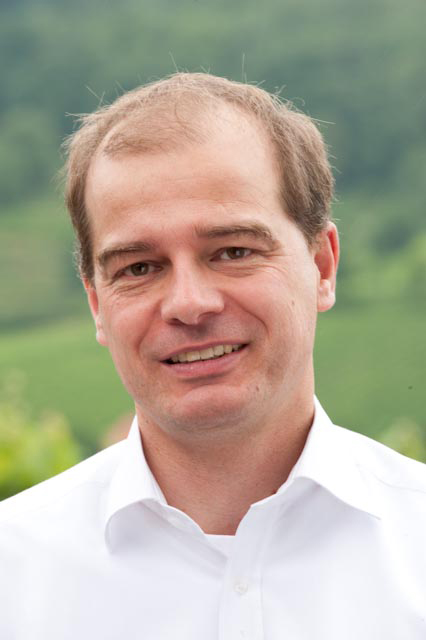


Dr. Kristin Limbach
Deputy Director DFIU
Karlsruhe Institute of Technology
Hertzstr. 16
76187 Karlsruhe, Deutschland
Phone: +49 721 608-44460
E-Mail: Sekretariat
In the latest ASIMUTE interview, Dr. Max Kleinebrahm, Head of the Energy Demand & Mobility research group at KIT’s Institute for Industrial Production (IIP), discusses his path into energy research and his work on the project. He reflects on the earlier projects that shaped his career and explains why he is particularly interested in how technological possibilities, economic decisions, and human behavior interact.
In Work Package 9, which he coordinates, we develop methods to optimize the operation of energy systems in residential buildings. These methods consider energy costs, greenhouse gas emissions, peak electrical loads, and thermal comfort. The aim is to identify suitable compromises between these sometimes conflicting requirements.
ASIMUTE investigates how energy demand, renewable generation, and storage can be better coordinated. Partners from Germany, France, and Switzerland examine technical solutions as well as household expectations and the legal frameworks in the Upper Rhine region. We contribute to Work Packages 3, 4, and 9.
The entire interview with Max Kleinebrahm and earlier interviews with other project members are available on the ASIMUTE project website.
Further information about the project ASIMUTE.
On August 04, our collaborators Corinne Faure and Joachim Schleich from the Grenoble Ecole de Management in France visited the DFIU to discuss our joint annual survey on the energy transition in Germany and France. Together, we discussed our recent outputs, including conference presentations, collaborative research papers, and possible extensions. Special focus was granted to the survey’s objectives for this year’s data collection, methodology and thematic extensions to heating and cooling policies. We also explored ideas for new focus modules addressing beliefs and behaviours relevant to the energy transition in both countries.
Last week, on June 24th, the DFIU and the Grenoble Ecole de Management (GEM) organized a webinar to present insights from the past three years of our ongoing binational survey on public support for the energy transition in France and Germany. The webinar focused on three key questions: 1. Does the public support the energy transition and their country’s climate targets? 2. To what extent does the public support the use of various energy sources for electricity generation, such as renewables, nuclear, and gas? 3. What are the public's perceptions regarding French-German cooperation in the energy transition, and how do these views vary based on political orientation? Participants from different countries discussed the implications within the context of national energy and climate policies.

DFIU welcomes two students from the University of Waterloo for a summer internship: Ms Gianna Glenny and Ms Isabella St Louis will be working with Dr. Kristin Limbach on a mini-research project. In the scope of the IMPULSE program, both are conducting their stay in at KIT from May until August 2026. Next to initial insights into the research of the chairs for energy economics and industrial production, the KIT ‘s international office has programmed several gatherings, excursions and site visits to Campus North and South with the group of visiting students.

On May 16, 2025, the DFIU hosted the DFIU Day and Workshop in Karlsruhe – a lively gathering of our partners, fellow researchers, and doctoral candidates from France and Germany. The event was dedicated to cross-border dialogue in environmental research and higher education. In collaboration with our EUCOR partners, the day promoted scientific exchange, interdisciplinary reflection, and the emergence of new project ideas in a vibrant international setting. The day concluded with a poster session and a delicious buffet. You can consult the workshop program here.

This central question is the focus of our upcoming institute colloquium at the Chair of Energy Economics at the IIP, where we are delighted to welcome Prof. Jan-Horst Keppler from the University Paris-Dauphine.
In his lecture "System Effects in Integrated Low Carbon Electricity Systems and the Need to Move Towards Hybrid Markets," Prof. Keppler will explain why hybrid electricity markets are essential for meeting climate goals. He will highlight how an optimal interplay of various technologies can reduce investment risks while ensuring a resilient and efficient market structure.
When: Tuesday, April 8, 2025, 1:30 PM – 3:00 PM
Where: Building 05.33, Room 103, Institute for Industrial Production (IIP), Campus West, Hertzstraße 16, Karlsruhe
The seminar is open to all interested parties – external participants are warmly welcome!
We look forward to your participation and engaging discussions on the future of energy economics.